Most of us were taught the same thing on our first lesson: cinch that harness down so it doesn't ride up. Fair enough. A harness up in your armpits is no fun.
But I see a lot of kiters who've taken it way past snug. And a harness squeezing your ribs and waist on every session changes how your core handles pressure. Your pelvic floor is usually the first place you feel it.
Your core is a pressure canister
Think of your trunk as a soda can. The diaphragm is the lid, your pelvic floor is the base, and your deep abdominals and back muscles are the walls. Every time you breathe, brace, pop, or land, those four parts work together to build and release pressure inside the can. That pressure is what stiffens your spine and lets you hold the power of the kite.
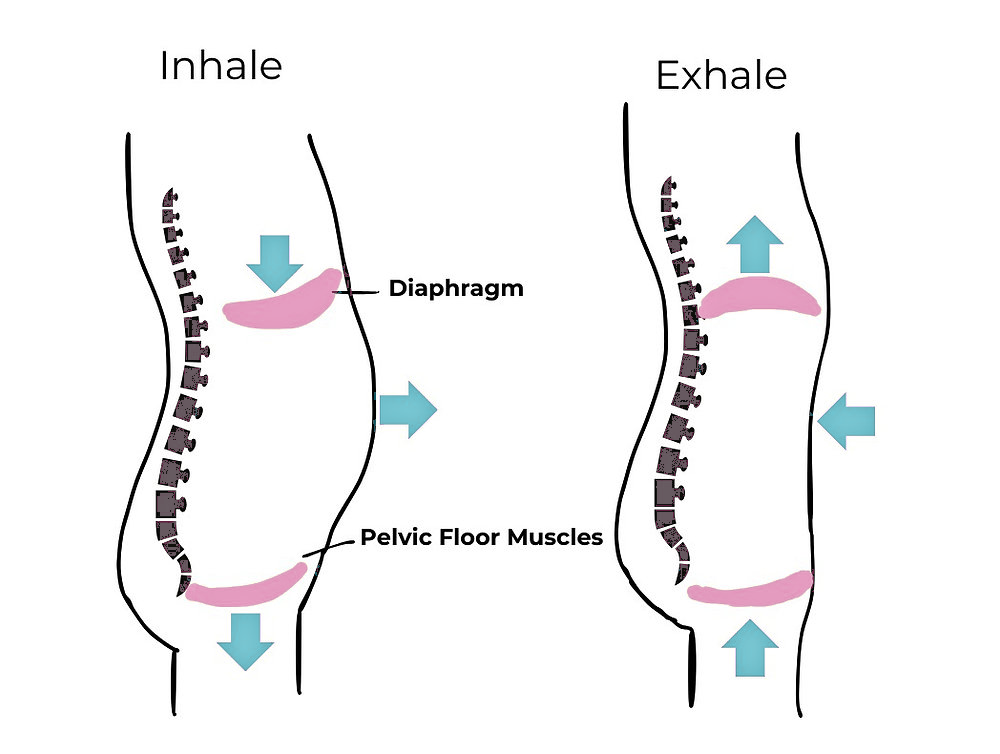
The diaphragm has two jobs: breathing and helping stabilize your trunk. Research shows that when breathing demand goes up, the diaphragm's stabilizing work drops off, and so does the deep abdominal muscle that wraps your waist (Hodges et al., 2001). In other words, when breathing gets hard, your core's stability gets the leftovers.
What a too-tight harness does
A healthy canister spreads pressure out in every direction. Your lower ribs expand sideways and back, your belly moves, and the pelvic floor lengthens and recoils with each breath.
Clamp a stiff band around the walls of that can and the pressure still has to go somewhere. It can't go out to the sides, so the two directions left are up (shallow, chest-only breathing) and down (onto the pelvic floor). Now add a hard landing, a heavy edge, or a gust on top of that.
Here's what I see in clinic when pressure isn't being spread through the whole system:
- Leaking on landings, big pops, or getting yanked by a gust
- A feeling of heaviness or pressure down below after a long session
- Low back or rib pain
- Breath holding through every move, then feeling cooked after 45 minutes
- A pelvic floor stuck "on," gripping because the walls of the can aren't doing their share
A tighter harness isn't more support. It just moves the load somewhere else, and the pelvic floor ends up taking it.
To be straight with you: nobody has studied kite harnesses and the pelvic floor directly yet. This comes from how the pressure system works, plus what I see in my riders. It's also exactly why I think it's worth checking.
Rib injuries: the hidden hit to your core
Rib and chest injuries are some of the most common injuries in kiting. In a prospective study of 235 kitesurfers, the chest made up 13% of injuries, third after the foot and ankle and the head (Nickel et al., 2004). In a 2026 survey of more than 3,000 kitesurfers, rib injuries were 12% of all reported injuries, and the authors flagged rib trauma as a cause of considerable time off the water (Offerhaus et al., 2026).
A bruised or cracked rib, or a strained muscle between the ribs, hurts every time you breathe. So you start guarding: shallow breaths, braced abs, no rib expansion on the sore side. That's a smart short-term strategy. The problem is it can stick around long after the rib has healed. The lid of your canister stops moving properly, and the walls and base pick up the slack.
If you've had a rib injury and now notice new leaking, back pain, or that your breath feels "stuck" on one side, those things may well be connected.
What you can do today
1. Do the harness breath test
Put your harness on at the setting you ride with. Place your hands on your lower ribs and take a slow breath in through your nose. Can your ribs widen into your hands, sideways and back? If the harness stops them cold, it's probably tighter than it needs to be. Snug enough not to ride up, loose enough to breathe.
2. Exhale on the effort
Before a pop, a landing, or a hard edge, breathe out, don't hold. A gentle exhale lets your pelvic floor and deep abs rise and brace together instead of everything bearing down.
3. Re-train rib expansion after an injury
Once your doctor has cleared the rib, lie on your side with the injured side up and a hand on those ribs. Breathe slowly into your hand for a few minutes a day. Getting that side of the canister moving again is one of the first things I work on.
4. Don't ignore the small leaks
Leaking with impact is common in athletes, but common doesn't mean you have to live with it. It's a sign the system needs some attention, not a sign you need to quit.
When to see a pelvic floor physical therapist
If you leak, feel heaviness, have pain on the water, or your breathing hasn't felt right since a crash, get assessed. I look at the whole system: breath, ribs, deep core, pelvic floor, and the way you actually ride, including your harness. And if a rib injury could be a fracture, see a doctor first.
References: Hodges PW, Heijnen I, Gandevia SC. Postural activity of the diaphragm is reduced in humans when respiratory demand increases. J Physiol. 2001;537(3):999–1008. · Nickel C, et al. A prospective study of kitesurfing injuries. Am J Sports Med. 2004;32(4):921–927. · Offerhaus C, et al. Injuries in kitesurfing: a retrospective cross-sectional survey on injury patterns based on discipline and skill level. BMC Sports Sci Med Rehabil. 2026;18:114.
This article is education, not a diagnosis. Talk to your doctor or physical therapist about your own symptoms.