If you've ever mentioned pelvic floor issues to a friend, a fitness instructor, or even a well-meaning doctor, you've probably heard the same advice: do your Kegels. Squeeze, strengthen, repeat.
Here's the thing almost nobody tells you: for a huge number of people, that's exactly the wrong advice.
The muscle that never clocks out
Your pelvic floor is a hammock of muscles at the base of your pelvis. Everyone has one, men and women alike. It supports your organs, controls your bladder and bowels, plays a starring role in sexual function, and works with your diaphragm and deep core every single time you breathe.
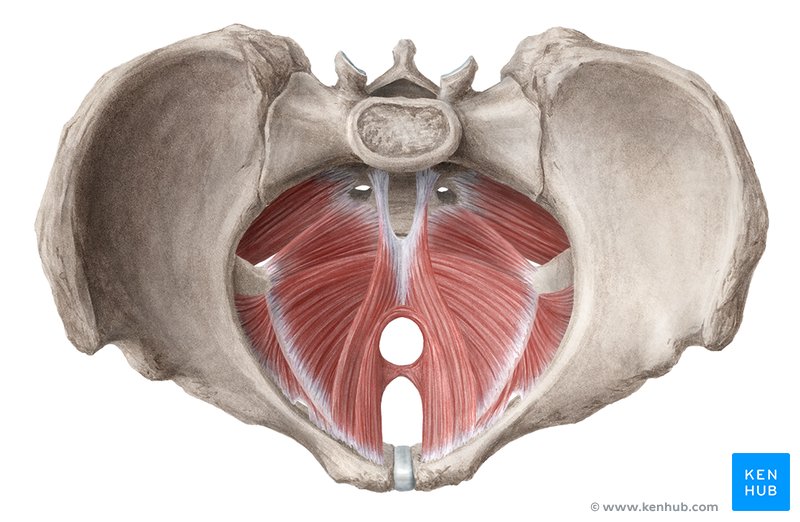
Like any muscle, it has two jobs: contract and relax. And like any muscle, it can get stuck in "on" mode. Think about how your shoulders creep up toward your ears during a stressful week. Your pelvic floor can do the same thing, gripping and clenching all day, and you'd never know, because you can't see it in the mirror.
This is called an overactive (or hypertonic) pelvic floor, and in my practice it's at least as common as a weak one. Active men and women are especially prone to it. Heavy training, core gripping, breath holding, and high-stress lifestyles all teach the pelvic floor to stay switched on.
Signs your pelvic floor may be overactive
- Urgency or frequency, feeling like you always have to pee
- Difficulty fully emptying your bladder, or a slow, hesitant stream
- Pain with sex or intimacy, or with tampon insertion or pelvic exams
- Constipation or straining
- Pelvic, hip, tailbone, groin, or low back pain that won't stretch out
- Leaking despite faithfully doing Kegels. A tight muscle is a weak muscle
If any of these sound familiar, more squeezing won't fix it. A muscle that's already maxed out has nothing left to give. It needs to learn to let go first. That's where down-training comes in.
It helps to see the two ends of the spectrum side by side. Same muscle group, two very different problems, and two very different fixes:
Too tight
Hypertonic / overactive
- Pain or burning with entry
- Difficulty with penetration or tampons
- Can clench but can't relax
- Common in athletes and "always-on" cores
Too weak
Hypotonic / underactive
- Leaking with impact, sneeze, jump
- Reduced sensation or grip
- Heaviness or prolapse symptoms
- Often postpartum or deconditioned
The goal isn't "stronger." It's a pelvic floor that contracts and fully relaxes on demand.
What down-training actually is
Down-training is the practice of teaching your pelvic floor to relax and lengthen. It's not passive. It's a skill, and like any skill, it improves with practice. Here's where I start with clients:
1Diaphragmatic breathing
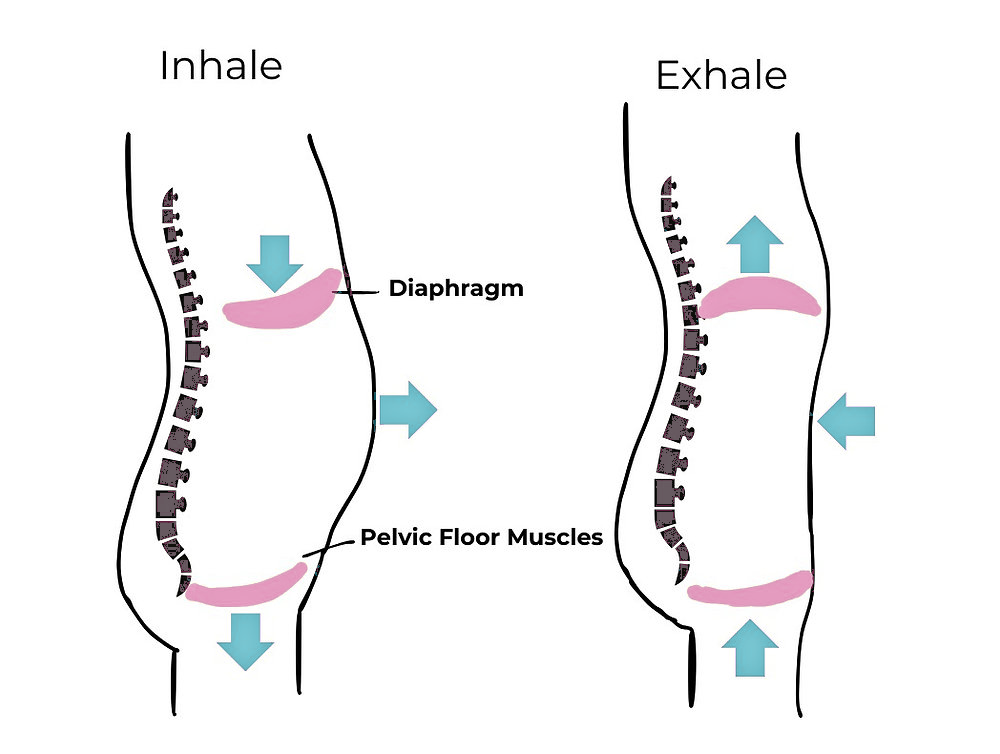
Your diaphragm and pelvic floor are partners. When you inhale deeply, your diaphragm descends and your pelvic floor naturally lengthens. Lie on your back with knees supported, one hand on your ribs and one on your belly. Inhale slowly through your nose, let your ribs expand in all directions, and imagine your pelvic floor softening and opening. Exhale gently, without pushing or gripping. Five minutes a day changes things.
2Positions that let gravity help
Child's pose, happy baby, and deep supported squats put the pelvic floor in a lengthened position. Combine them with the breathing above and you've doubled the effect.
3Full relaxation on the toilet
No hovering, no straining, no rushing. Feet supported (a small stool helps), body relaxed, exhale as you go. Your pelvic floor should never have to fight you here.
4Check in during your day
Set a reminder: are you clenching your glutes, sucking in your stomach, gripping your jaw? They travel together. Notice, exhale, soften.
When to see a pelvic floor physical therapist
If symptoms have stuck around for more than a few weeks, or if pain, leaking, or pressure is changing how you move, train, or live, it's worth getting assessed. A pelvic floor PT can tell you whether your floor is overactive, underactive, or a bit of both (very common), and build a plan that fits your body instead of a one-size-fits-all Kegel prescription.
Ready to figure out what your pelvic floor actually needs?
I offer one-on-one evaluations and work with active men and women who want to keep surfing, riding, training, and living without pelvic symptoms holding them back.
Book a Free, Private Consultor DM @fullsendphysicaltherapy
Recommended reading: Floored: A Woman's Guide to Pelvic Floor Health at Every Age and Stage by Dr. Sara Reardon, PT, DPT.